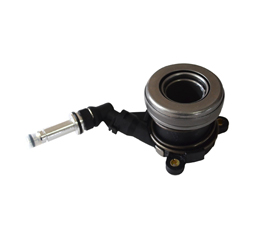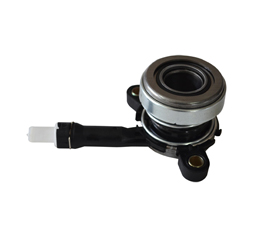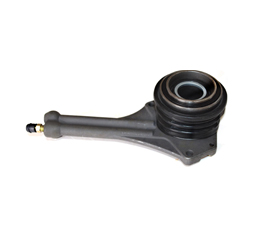

AMT and DCT clutch actuator systems are designed to automate clutch operation, but they serve different transmission architectures and driving requirements. An AMT clutch actuator is mainly used in automated manual transmissions, offering a cost-effective solution with simpler mechanical structures. A dual clutch actuator is developed for dual-clutch transmissions, enabling faster gear shifts, higher efficiency, and smoother power delivery. Both systems rely on advanced electronic clutch actuator technology to achieve precise clutch control, but their applications differ significantly.
For vehicle manufacturers, choosing between AMT and DCT clutch actuator systems depends on factors such as vehicle positioning, cost targets, shift performance requirements, and production strategy.
The main difference between AMT and DCT clutch actuator systems is the transmission structure they control.
An AMT system is based on a traditional manual transmission with automated clutch and gear shifting. The actuator operates a single clutch, replacing the driver’s clutch pedal operation. In contrast, a DCT system uses two separate clutches to control odd and even gear sets, requiring a more advanced dual clutch actuator capable of managing two clutch mechanisms simultaneously.
| Feature | AMT Clutch Actuator | DCT Clutch Actuator |
|---|---|---|
| Transmission Type | Automated Manual Transmission | Dual Clutch Transmission |
| Clutch Quantity | Single clutch | Two clutches |
| Control Complexity | Moderate | High |
| Shift Speed | Moderate | Very fast |
| Cost | Lower | Higher |
| Driving Feel | Similar to manual transmission | Similar to automatic transmission |
| Main Applications | Economy cars, commercial vehicles | Passenger cars, performance vehicles |
From an actuator engineering perspective, DCT systems require higher control accuracy, faster response time, and more complex calibration because the actuator must coordinate clutch engagement and pre-selection strategies.
An AMT clutch actuator automates clutch engagement and gear shifting by replacing traditional mechanical controls with electronic and hydraulic or electromechanical systems.
The actuator receives signals from the transmission control unit (TCU) and controls:
Clutch engagement and disengagement
Gear shift mechanism operation
Torque interruption management
Modern AMT systems commonly use an electronic clutch actuator to improve control precision and reduce mechanical complexity. Compared with traditional manual systems, AMT provides improved fuel efficiency while lowering manufacturing costs.
AMT clutch actuators are widely used in:
Compact passenger vehicles
Entry-level electric and hybrid platforms
Light commercial vehicles
Fleet vehicles requiring durability and low maintenance costs
The key advantage of AMT technology is its balance between automation and affordability.
A dual clutch actuator controls two independent clutches in a dual-clutch transmission.
One clutch manages odd-numbered gears (1, 3, 5, etc.), while the other controls even-numbered gears (2, 4, 6, etc.). During operation, the transmission can pre-select the next gear, allowing almost uninterrupted power transfer during shifting.
A dual clutch actuator typically integrates:
High-precision position control
Fast response mechanisms
Electronic control communication
Hydraulic or electromechanical actuation technology
Compared with AMT systems, DCT actuators require more sophisticated control algorithms because they must coordinate clutch overlap, torque transfer, and shift comfort.
This makes the dual clutch actuator a critical component affecting:
Shift smoothness
Transmission efficiency
Driving performance
Vehicle reliability
The development of the electronic clutch actuator has become a major trend in transmission technology.
Traditional mechanical clutch systems depend heavily on driver input and mechanical linkages. Electronic clutch actuators replace these components with electronically controlled systems that provide:
Faster response
More accurate clutch positioning
Better integration with vehicle control systems
Improved fuel efficiency
Compatibility with hybrid and electric vehicle platforms
For OEMs and transmission suppliers, electronic control capability is becoming increasingly important as vehicles require smarter powertrain management.
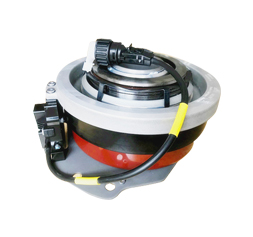
Neither system is universally better; the choice depends on vehicle application.
AMT systems are preferred when manufacturers prioritize:
Lower production cost
Simple maintenance
High reliability
Fuel economy
DCT systems are preferred when manufacturers require:
Faster gear shifts
Better acceleration performance
Premium driving experience
Higher transmission efficiency
For economy vehicles and commercial applications, AMT remains a practical solution. For higher-performance passenger vehicles, DCT with advanced dual clutch actuator technology provides superior driving characteristics.
AMT clutch actuators are commonly applied in vehicles where cost efficiency and durability are key priorities.
Typical applications include:
AMT systems are used in small and compact vehicles where automatic driving convenience is required without the cost of a traditional automatic transmission.
Light trucks and fleet vehicles benefit from AMT technology because of its durability and reduced driver workload.
Some hybrid architectures use AMT-based systems combined with electronic clutch actuator technology for efficient power management.
Dual clutch actuator systems are mainly used in vehicles requiring fast and smooth gear changes.
Common applications include:
DCT systems provide rapid shifting and improved acceleration response.
Manufacturers use DCT technology to enhance driving comfort and efficiency.
Advanced dual clutch actuator designs support integration between combustion engines and electric motors.
Vehicle manufacturers usually evaluate several technical factors before selecting an actuator solution:
The actuator must match the mechanical structure and control requirements of the transmission.
Budget vehicles typically favor AMT solutions, while premium models often require DCT technology.
DCT systems demand more advanced electronic control and calibration capabilities.
AMT actuators generally offer lower system costs, while DCT actuators require higher investment due to their complexity.
For suppliers, actuator reliability, response accuracy, durability testing, and customization capability are essential factors in supporting OEM applications.
AMT clutch actuator and dual clutch actuator systems represent two different approaches to automated transmission control. AMT provides a cost-effective and reliable solution for vehicles where efficiency and affordability are priorities. DCT systems, supported by advanced dual clutch actuator technology, deliver faster shifting and improved driving performance for higher-end applications.
With the increasing demand for intelligent vehicle control, the role of electronic clutch actuator technology will continue to expand. Selecting the right actuator system requires a balance between transmission design, vehicle requirements, performance targets, and manufacturing costs.
As an experienced clutch actuator supplier, KGC Clutch focuses on developing reliable actuator solutions that meet the evolving needs of global automotive manufacturers.
An AMT clutch actuator is a device that automatically controls clutch engagement and gear shifting in an automated manual transmission.
A dual clutch actuator controls two clutches in a DCT system to enable faster and smoother gear changes.
No. They are designed for different transmission structures and require different control systems.
DCT clutch actuators are generally more expensive because they require higher precision and more complex control functions.
It provides faster response, improved control accuracy, and better integration with modern vehicle systems.
 English
 Español
 português